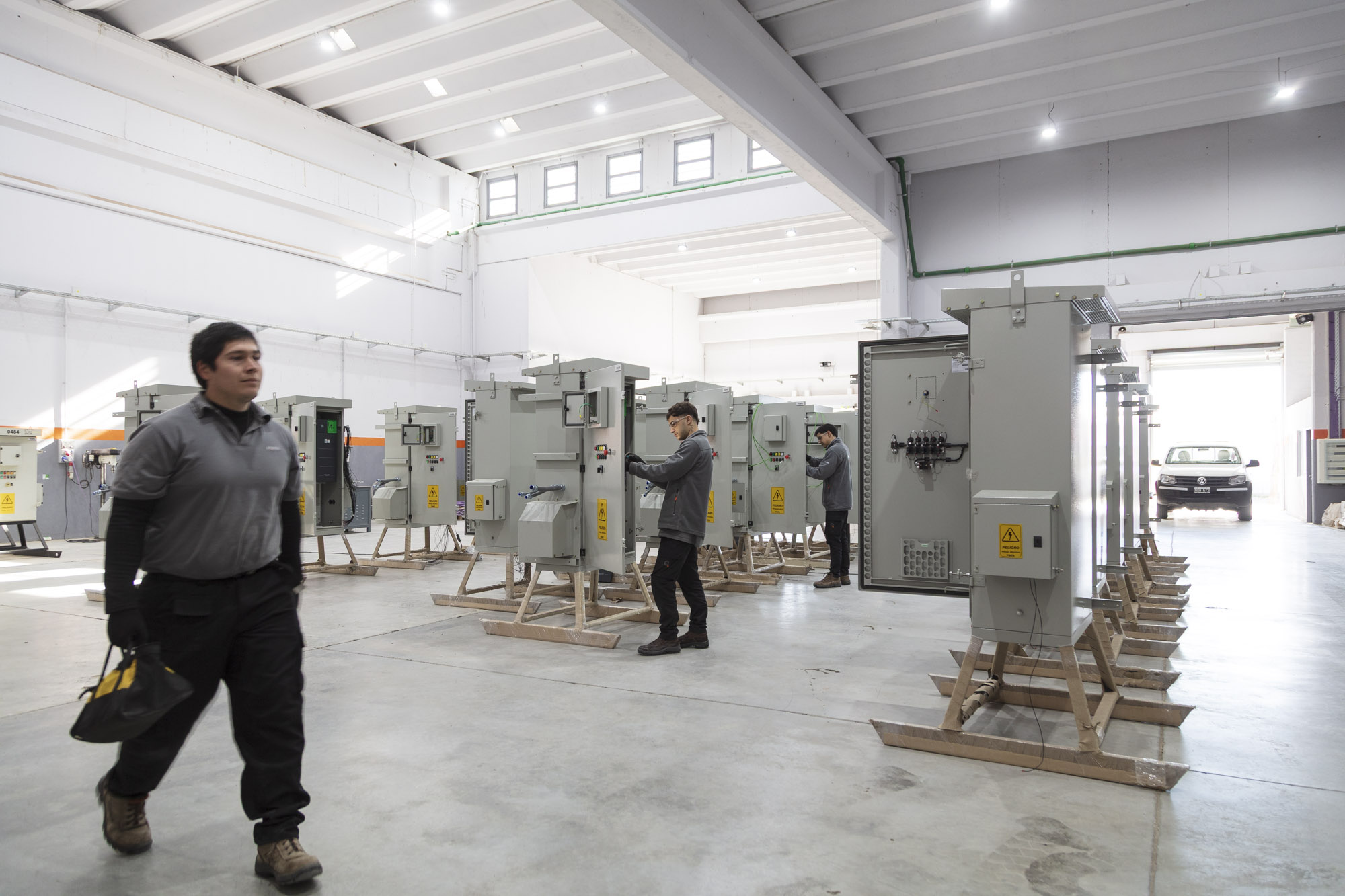
Electrical Switchboards and Rooms
Solar skid: autonomous power and remote monitoring for Oil & Gas and isolated sites

A solar skid is an autonomous generation solution mounted on a structural frame that integrates within a single assembly the primary components necessary to produce, store, manage, and deliver electrical energy. Depending on the project, it can integrate photovoltaic panels, lithium batteries, charge controllers, inverters, DC/DC converters, protections, an electrical panel, and communication systems. Unlike a conventional photovoltaic installation distributed across different areas, the skid concept aims to concentrate the system into a pre-integrated unit, facilitating its transport, installation, and field commissioning. This type of architecture is particularly utilized in applications requiring a fast, relocatable solution ready to operate off-grid.
Its primary function is to deliver reliable energy to locations where extending the electrical grid is unfeasible, costly, or simply impossible. It can also be used to isolate a specific load from the existing electrical infrastructure or to replace or reduce dependency on generator sets in certain applications. The key distinction is that there is no single model suitable for all cases: a skid designed to power telecommunications 24 hours a day requires different sizing than one dedicated to instrumentation, cameras, pumps, valves, or control systems. Therefore, the installed capacity and storage capacity must be defined based on the actual needs of the site.
Operation is based on a continuous energy balance. During hours of solar availability, the photovoltaic modules generate direct current, and an MPPT controller aims to operate the solar array near its maximum power point. This energy can simultaneously power the loads and charge the batteries. When photovoltaic production decreases or ceases—for example, during the night—the batteries take over to sustain the installation. The management system and the battery BMS supervise variables such as voltage, current, state of charge, and temperature, while the electrical protections isolate the various circuits under abnormal conditions. In off-grid systems, the balance between production, consumption, and storage must be analyzed continuously and not solely based on average daily values.
This architecture also enables a particularly useful feature in the field: the same skid can power loads with different voltages. For example, a 51.2 Vdc battery bank can coexist with 12 Vdc, 24 Vdc, and 48 Vdc outputs, utilizing the corresponding DC/DC conversion stages, while simultaneously delivering 220/230 Vac via an inverter. This allows supplying everything from direct current instrumentation and telecommunications to conventional alternating current equipment. The fact that these outputs can coexist does not mean they are independent of the sizing: the power of each converter, the inverter, the maximum current of the conductors, and the protections of each branch must be calculated based on the projected loads.
One of the central design parameters is autonomy. The question is not simply how many batteries to install, but for how long the installation must continue to operate when photovoltaic generation is insufficient or non-existent. If a load consumes continuously, the bank must have sufficient useful energy to cover that period while respecting the permitted depth of discharge, conversion efficiencies, temperature conditions, and the reserve margin defined for the project. Professional off-grid system sizing tools, such as PVsyst, explicitly consider the load profile, the required autonomy, and the meteorological resources to determine the appropriate relationship between the photovoltaic field and storage.
Just as important as autonomy is daily recovery. After a night or a period of low generation, the photovoltaic field must produce enough energy not only to meet consumption while the sun is shining, but also to recover the energy drawn from the batteries. Therefore, sizing a skid solely based on Peak Sun Hours can lead to incomplete conclusions. The PSH is an equivalent measure of energy: for example, five PSH represent a daily irradiation equivalent to five hours at 1,000 W/m²; it does not mean that the panels are delivering their nominal power for five consecutive hours. For critical systems, it is necessary to analyze the hourly irradiance and consumption profile, along with module orientation and tilt, temperature, shading, and system losses. Indeed, PVsyst supports hourly and sub-hourly load profiles precisely to analyze these variations.
Batteries designed to operate in low temperatures
At this point, a particularly important feature of the skid emerges: the batteries incorporate an active thermal blanket. This is not simply an insulating cover to maintain temperature, but rather a heating system that supplies heat to the cells when environmental conditions require it. In LiFePO₄ chemistry batteries, charging at sub-zero temperatures must be carefully controlled because it can lead to metallic lithium deposition on the anode—lithium plating—and cause permanent degradation. Some batteries incorporate heating films or elements that raise the temperature of the cells before enabling charging. In a skid destined for cold climates, this feature significantly expands the range of applications, though the consumption of the heating system itself must also be included in the autonomy balance. (BSLBATT)
A solution particularly useful for Oil & Gas
The features of the solar skid are highly relevant for the oil and gas industry, where a significant portion of instrumentation and control systems is distributed over vast areas and often far from a conventional electrical supply. Common off-grid solar power applications in upstream and midstream include telemetry RTUs, SCADA systems, remote metering, valve control, injection pumps, cathodic protection, communications, and monitoring equipment. It can also power cameras, sensors, detection devices, and other low- and medium-power auxiliary services. In sites with hazardous areas, however, being
Related News