Renewable Energy
Solar panels for industries: energy savings, security, and integration with the conventional grid
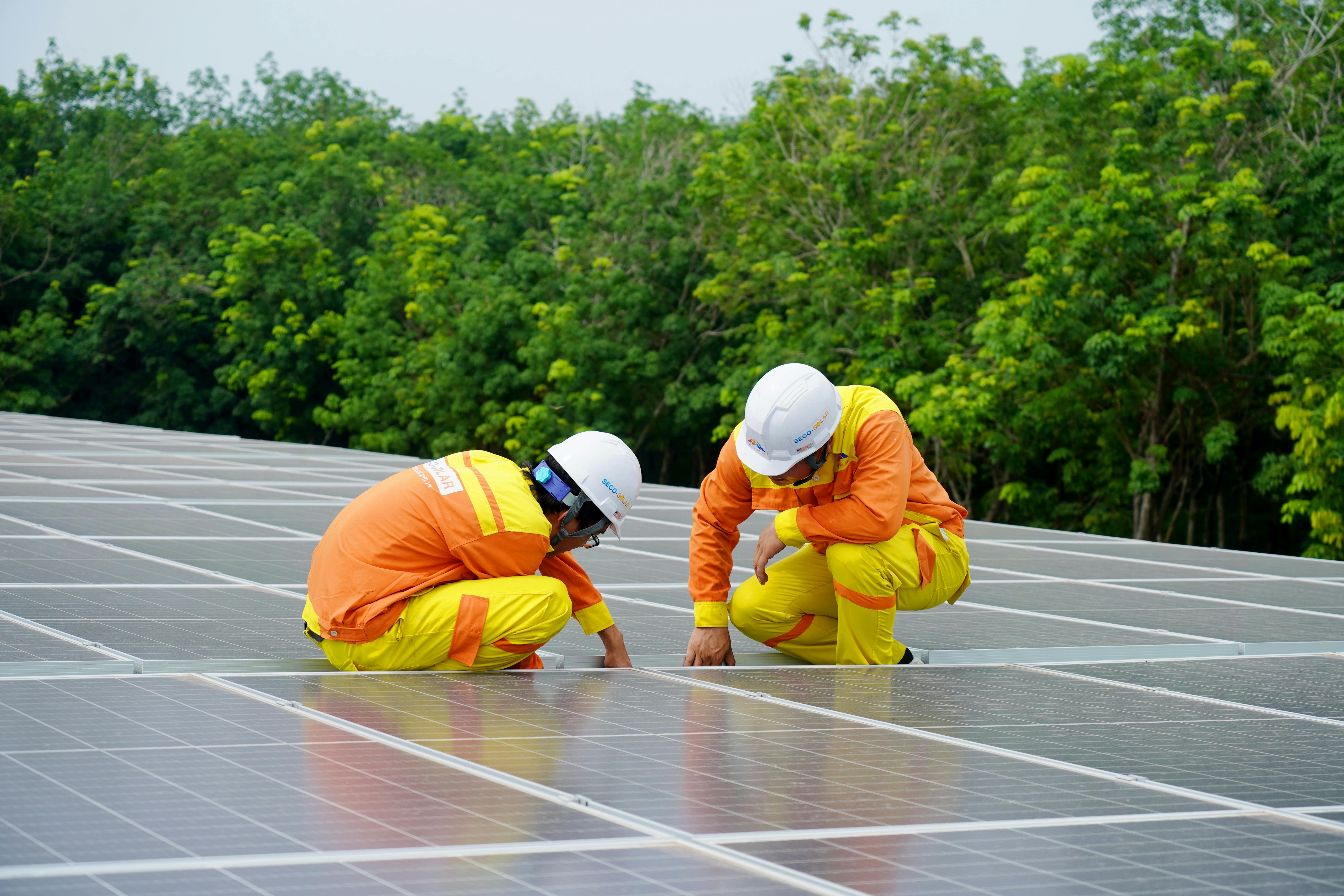
Photovoltaic solar panels convert solar radiation into direct current electricity. The modules are connected to form strings, whose energy reaches one or more inverters. This equipment performs maximum power point tracking (MPPT) and transforms direct current into alternating current synchronized with the industrial facility. The generated energy is typically consumed within the plant, reducing the electricity drawn from the grid. Equipel develops solutions that include panels, inverters, structures, protections, batteries, and the necessary components for commercial and industrial applications, providing support in sizing, design, assembly, and commissioning. Equipel – Renewable Energies.
It is important to make an initial distinction: panels do not inherently reduce the electrical consumption of machinery. The plant continues to use the energy required for its process, but a portion of that demand is covered by solar generation. The economic savings arise from purchasing less energy from the utility company or from reducing the use of generator sets. Fixed charges, contracted power, and certain demand charges may remain, especially when peak consumption occurs during hours without sufficient radiation. Therefore, a professional economic evaluation must separate energy (kWh), power (kW), maximum demand, reactive energy, and tariff structure.
How solar energy is combined with conventional energy
In a grid-connected installation, the solar inverter synchronizes voltage, frequency, and phase with the plant's electrical system. If the industry demands 800 kW and the panels are generating 300 kW, approximately 300 kW will be supplied by the solar system and the remaining 500 kW will come from the grid. If a cloud momentarily reduces generation to 100 kW, the grid automatically delivers the difference. No noticeable switching occurs between the two sources: they work in parallel, and the balance changes continuously.
Architecture | Operation | What happens during an outage |
On-grid solar | Panels supply part of the demand, and the grid delivers the difference. Surplus energy can be injected if authorized. | The inverter disconnects due to anti-islanding protection. The plant remains without power unless it has another backup. |
On-grid solar with zero injection | A meter and a controller adjust generation to prevent or limit flow to the grid. | It also disconnects during an outage, unless a hybrid architecture is in place. |
Hybrid solar with batteries | Panels supply loads and charge batteries. Storage can be used for backup, load shifting, or peak shaving. | Previously selected loads can continue to operate during the available autonomy period. |
Microgrid with solar, batteries, and generator | A control system coordinates grid, PV, storage, generators, and loads. | It can disconnect from the grid and operate in island mode if designed for that function. |
A conventional on-grid system is not a backup system. Even in full sunlight, it must stop energizing the facility when the grid goes down to prevent an electrical island that could endanger personnel and equipment. When continuity is a priority, a hybrid solution or a microgrid with storage, control, protections, and a safe separation mechanism at the common coupling point is required. Schneider Electric describes microgrids as systems capable of working grid-connected or in island mode, combining distributed generation, batteries, and, typically, backup generators.
How to achieve real savings
Sizing must begin with the industry's load curve, ideally obtained through measurements with sufficiently short intervals over a representative period. It is not enough to analyze the monthly bill total. It is necessary to know how much the plant consumes during solar hours, how demand varies between workdays and weekends, whether there are seasonal shutdowns, and when peak power occurs. Industries with a stable daytime load—such as refrigerated warehouses, process plants, logistics centers, wineries, agro-industrial facilities, pumping, water treatment, or continuous production—typically utilize a high proportion of generation at the same location where it is produced.
The energy simulation must incorporate the site's solar resource, temperature, orientation, tilt, shadows, soiling, electrical losses, inverter efficiency, unavailability, and planned degradation. The most useful indicators are the estimated annual production in kWh, the specific yield in kWh/kWp, the self-consumption percentage, the solar fraction of demand, and the energy that must be limited or exported. The economic evaluation must consider initial investment, maintenance, insurance, potential replacements, tariff evolution, and financial cost. It is unprofessional to promise a generic savings percentage or payback period without analyzing this data.
Storage should not be added automatically either. A battery can increase self-consumption, shift solar energy to the night, limit peak demand, and support critical loads, but it introduces investment, conversion losses, maintenance, and degradation due to cycling. Its capacity must be defined in kWh based on the required energy, while the inverter or conversion system is sized in kW based on instantaneous power. The reserve dedicated to emergencies must also be separated from the capacity used daily for economic optimization. Schneider Electric integrates solar generation, storage, distribution, metering, and control as parts of the same electrical system.
Technical details that determine the result
Modules are not selected solely based on their nominal wattage. Cell technology, temperature coefficients, mechanical strength, product and power warranty, shading performance, electrical compatibility, and applicable certifications, such as IEC 61215 and IEC 61730, must be evaluated. In areas with aggressive environments, additional verifications against salt mist, ammonia, dust, humidity, or corrosion may be required. In Patagonia, wind loads, low temperatures, hail, snow, and stresses on roofs and structures also become important.
The configuration of each string must be verified for the extreme temperatures of the site. The sum of the open-circuit voltages (Voc) corrected for the minimum temperature must never exceed the maximum voltage allowed by the inverter, cables, disconnectors, and protections. At the same time, the operating voltage at high temperature must remain within the MPPT window. Maximum current per input, number of parallel strings, allowable reverse current for the modules, and the need for fuses must also be verified. A combination that works at 25 °C may exceed limits during an extremely cold morning or a high-temperature day.
The ratio between installed panel power and nominal inverter power (DC/AC ratio) is defined through simulation. A certain oversizing of the PV array can improve inverter utilization during hours of low irradiance, but an excess results in generation clipping and can exceed current or energy limits established by the manufacturer. In high-power installations, voltage rise, reverse flow, transformers, protection coordination, harmonics, power factor, medium-voltage connection, and compliance with utility requirements must also be studied.
Installation on roofs, ground, or carports
Before installing on an industrial building, the structural capacity of the roof must be reviewed, considering permanent weight, wind, snow, maintenance, and the condition of purlins, metal sheets, and fasteners. Penetrations and anchors must preserve watertightness and allow for thermal expansion. The layout must leave inspection walkways, equipment access, drains, evacuation areas, and distances compatible with the fire safety strategy. It must also be avoided that the mounting complicates future roof repairs.
A northern orientation typically maximizes annual production in the southern hemisphere, but it is not always the only convenient solution. An east-west configuration can make better use of certain roofs, allow for higher installed power, and distribute production over more hours, better matching some industrial consumption curves. The decision must be based on an hourly simulation rather than solely seeking the maximum yield of each panel. In ground-mounted installations, geotechnics, drainage, vegetation, erosion, access, and perimeter security must be evaluated. Carport-type structures allow for energy generation and provide shade, but they add requirements for circulation, clearance height, vehicle impact, and lighting.
Electrical safety: panels continue to generate
As long as they receive light, modules maintain voltage at their terminals. Opening the AC circuit breaker does not eliminate DC voltage from the PV array. Furthermore, DC arcing is particularly dangerous because it has no natural zero crossing like AC. For this reason, equipment specifically rated for DC, accessible disconnection, overcurrent protection when applicable, insulation fault detection or monitoring, grounding, equipotential bonding, signage, and lockout-tagout procedures are required.
Lightning and surge protection must result from a risk analysis and coordinate devices on both the DC and AC sides. Depending on the project, Type 2 or combined Type 1+2 surge protective devices may be used, with short connection conductors and proper equipotential bonding. Combiner boxes allow for grouping strings, incorporating fuses, disconnectors, monitoring, and surge protection before the inverter. Phoenix Contact offers configurations for 1000 and 1500 V DC systems, but the selection of the voltage level and type of surge arrester must correspond to the actual design of the installation.
Solar cables are also critical components. They must withstand ultraviolet radiation, temperature, humidity, movement, ozone, and the system's DC voltage throughout their service life. They should not rest on the roof, be subjected to sharp edges, or be exposed to water accumulation. Likewise, it is not recommended to combine connectors from different manufacturers simply because they appear compatible: differences in contacts, materials, or tolerances can increase resistance and generate hot spots. Prysmian points out that cables represent a small proportion of the total investment, but a failure can interrupt the entire generation.
Commissioning and maintenance
Acceptance must include mechanical inspection, torque control, polarity verification, Voc and Isc measurement per string, insulation resistance, continuity of protective conductors, inverter configuration, disconnection tests, anti-islanding, communications, measurement, and export limitation. Protection settings and the correct direction of current transformers and meters must also be verified. Recording irradiance and temperature allows for comparing measured production with existing conditions. Fluke notes that these initial measurements establish a baseline to subsequently detect shadows, defective modules, ground faults, differences between strings, and hot spots.
During operation, it is advisable to monitor production, inverter availability, alarms, insulation, currents per string, and imported or exported energy. Cleaning should be defined based on actual soiling losses, water availability, and environmental characteristics, rather than a generic calendar. Thermography, I-V curve analysis, and comparison between sectors help detect hot connections, damaged diodes, uneven shading, soiling, or degradation. Following extreme winds, hail, snow, or work on the roof, additional inspections should be performed.
Recommendations for an industry
Measure the load curve before defining the solar power capacity.
Prioritize self-consumption and establish from the outset whether grid injection will be permitted, limited, or prevented.
Do not confuse solar generation with backup power during outages.
Separate critical loads from the rest of the plant before sizing batteries.
Verify structure, wind, corrosion, shadows, and maintenance access.
Calculate each string for the actual extreme temperatures of the site.
Use cables, connectors, disconnectors, and protections specifically rated for direct current.
Integrate metering, monitoring, alarms, and energy management from the engineering phase.
Perform documented commissioning and retain drawings, calculations, configurations, and test results.
Compare alternatives based on annual production, self-consumption, availability, total cost, and operational risk, not solely on price per watt.
Equipel supports industrial projects from demand analysis and sizing to supply, assembly, and commissioning. Its experience in electrical materials, protections, measurement, automation, and switchboards allows for the integration of solar generation with the existing infrastructure of each plant. The true value of an industrial photovoltaic project lies not only in installing the largest possible number of panels, but in ensuring that the energy produced is used safely, measurably, and compatibly with operational continuity.
Related News